
Galena Headwaters: As Though It Has Always Been
-
Check-in29 Oct 2026
-
Check-out30 Oct 2026
-
Nights1 Night
-
Rooms1 Room
-
Number of people2 Adults • 0 Children
The Art of Being
Where stone, wood, and water belong—and moments are free to Simply Be.
Some places announce their arrival. Others seem to have always belonged.
Galena Headwaters is one of those places.
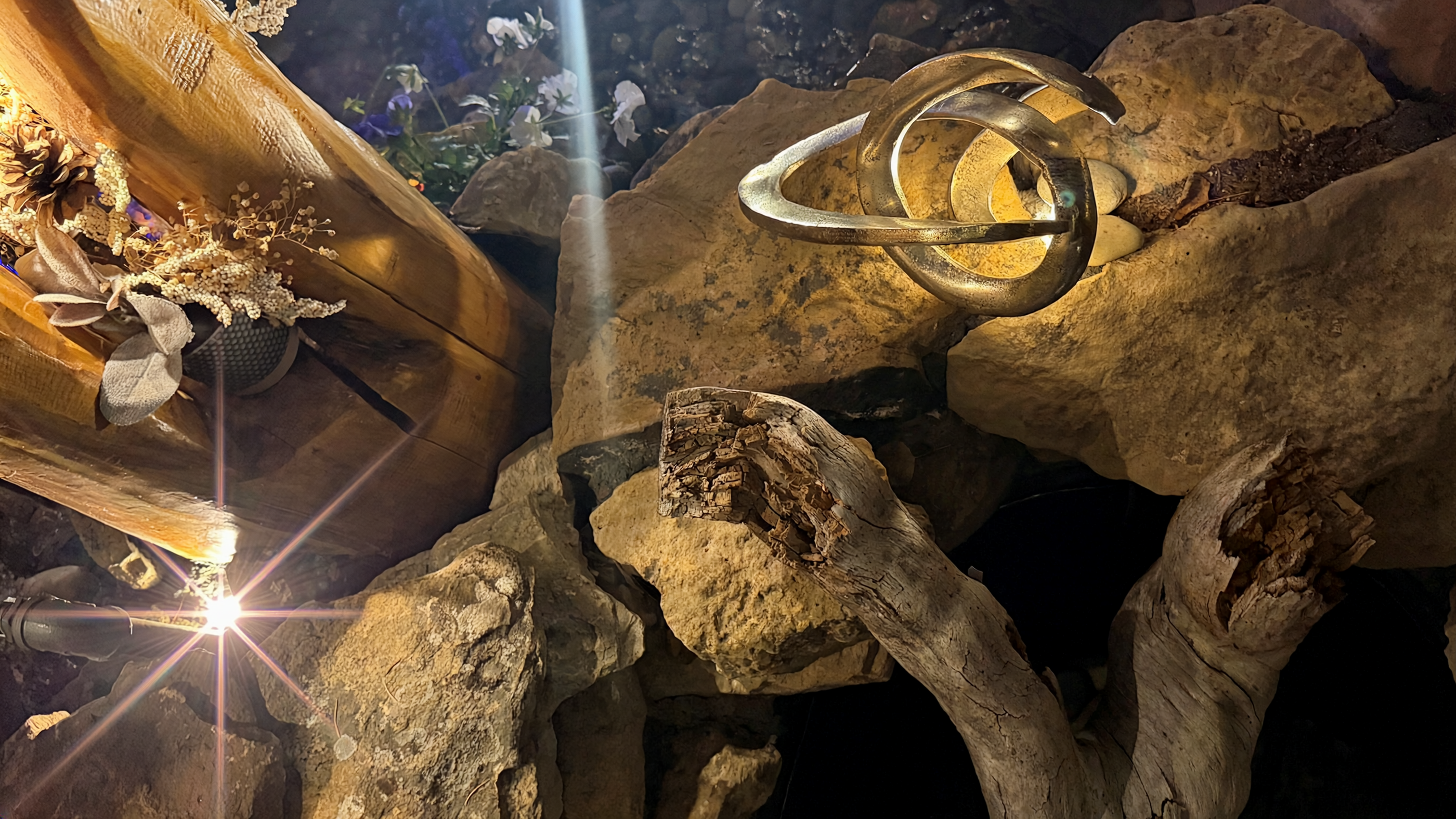
Tucked into the courtyard of the Frisco Inn on Galena, its sandstone ledges, weathered timber, original lodgepole sculptures, and winding waterways seem less like an arrangement of separate elements than a landscape discovered.
The rocks rise naturally toward the mountain imagery beyond. Water appears through narrow passages, follows the contours of stone, and disappears beneath fallen wood. The sculptures stand quietly among the formations, as though the landscape has grown around them over time.
Nothing asks to be understood immediately.
And perhaps that is what makes the place feel so natural.
Some landscapes are meant to be explored. Others seem simply to have always been.
Where Stone Finds Its Place
The sandstone of Galena Headwaters has many characters.
Near the upper reaches, jagged rocks suggest the fractured terrain of an alpine mountainside. Upright formations rise against distant mountain imagery, their irregular silhouettes evoking peaks and outcrops shaped by time.
Farther below, broad sandstone shelves extend over darker recesses. Smaller stones collect in narrow passages, while rounded river rock settles into the streambeds and beneath the water.
There is no insistence on symmetry.
Some rocks lean. Others project. Some rest quietly beneath their neighbors, while others create openings that invite the eye deeper into the landscape.
The differences feel natural because mountain geology rarely follows a predictable pattern.
And the spaces between the stones are as important as the stones themselves.
They suggest passages, shadows, and places where water may continue unseen.
The Trees That Remain
At the heart of Headwaters stand two original lodgepole trunks, still rooted where they once grew.
Their transformation into carved wildlife sculptures preserves a connection between the courtyard's past and present.
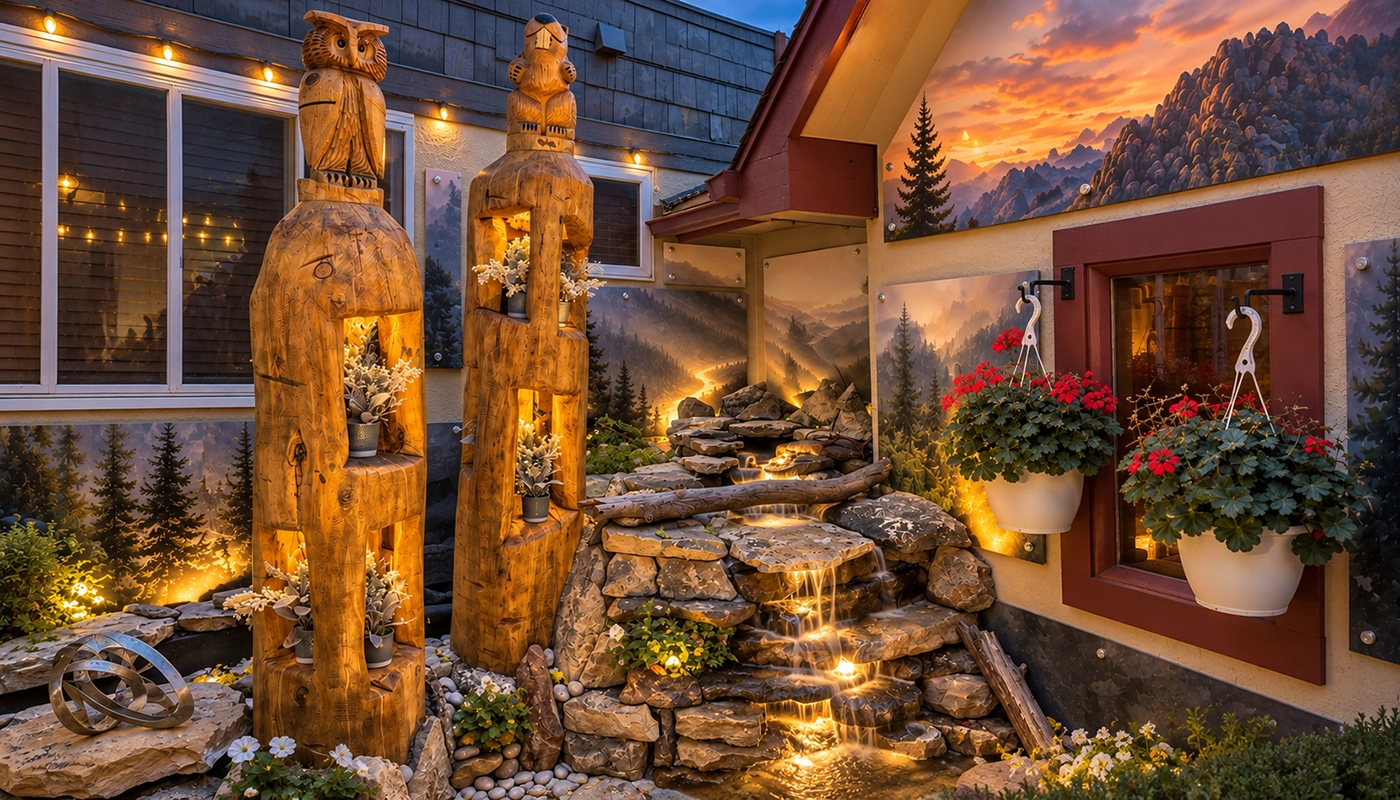
An owl and a beaver emerge from the wood, their forms reflecting the mountain environment surrounding Frisco.
Small botanical arrangements soften the carved openings, while warm illumination reveals the wood's texture after dark.
The sculptures do not appear separate from the landscape.
The sandstone gathers around their bases. Water moves nearby. Driftwood rests among the rocks.
The original trees remain part of the place, even as their form has changed.
What remains need not remain unchanged to continue belonging.
The Quiet Language of Water
Water moves through Headwaters in many ways.
Sometimes it announces itself, falling from a broad sandstone shelf into a pool below.
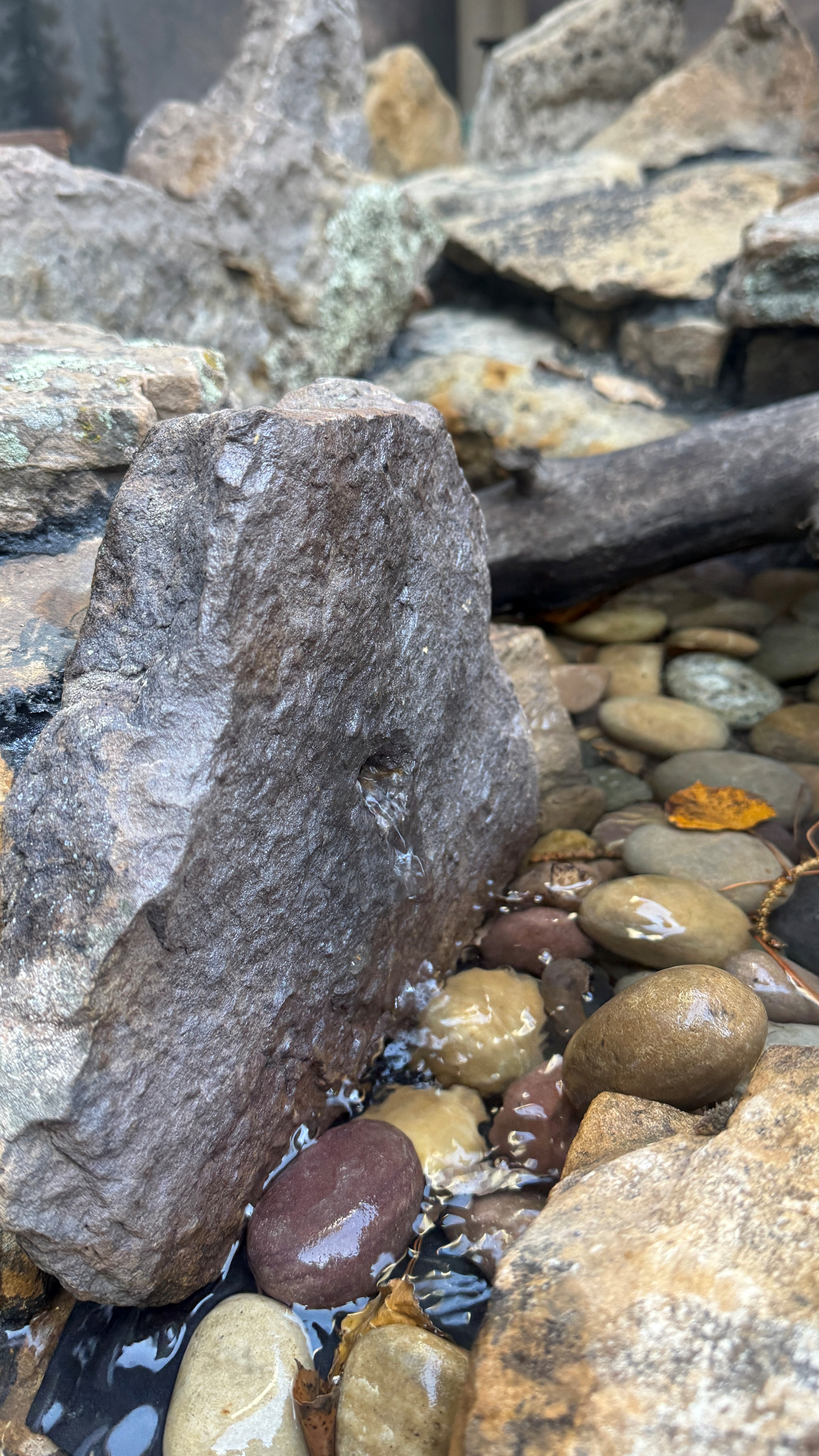
Elsewhere, it barely reveals its presence.
A small seep emerges through weathered rock.
An old brass faucet and a burnished copper pipe suggest water sources with histories of their own.
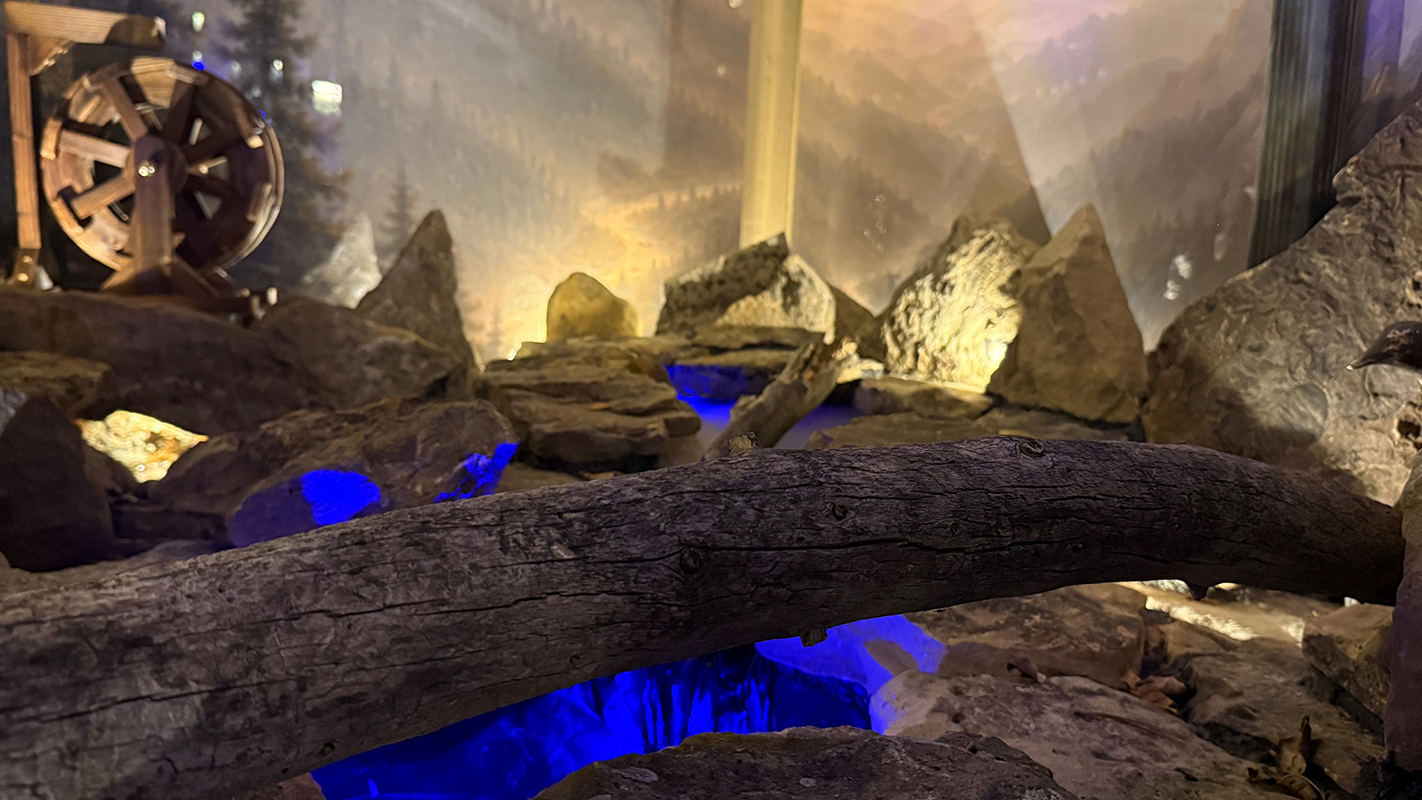
A wooden waterwheel turns gently within the upper landscape.
Water disappears beneath stone and timber, only to emerge again farther downstream.
These different movements give the landscape its rhythm.
There is no single waterfall demanding all the attention.
Instead, the eye follows one stream, notices another, and gradually discovers connections that were not immediately apparent.
And where the water cannot be seen, its sound suggests that the journey continues.
The Presence of Time
Weathered driftwood lies among the sandstone as though carried there by years of mountain runoff.
A long, curved branch crosses the upper rocks. Smaller pieces rest within narrow passages and beside quiet pools.
Their irregular shapes interrupt the stone's angular forms.
Their worn surfaces suggest movement, weather, and the passage of seasons.
Nothing appears deliberately arranged to tell a story.
Yet the landscape seems to hold one.
The driftwood suggests what the water has carried.
The rounded stones suggest what it has softened.
The fractured sandstone suggests what time has exposed.
And the original lodgepole sculptures connect those imagined histories to the actual history of the Inn.
A Landscape Beyond the Walls
The physical boundaries of Headwaters do not define the limits of its apparent landscape.
Beyond the sandstone, mountain murals suggest distant ridges, forests, and winding waterways.
Jagged foreground rocks overlap the painted mountains, allowing the eye to move naturally between what is near and what appears far away.
As the viewpoint changes, the relationship between stone and distant scenery changes with it.
The waterwheel occupies another layer within the composition.
Driftwood crosses the foreground.
Mist settles near the upper pond, softening the boundary between the physical landscape and the imagined mountains beyond.
The result is not an attempt to disguise the courtyard.
It is an invitation to see beyond its boundaries.
Sometimes a sense of distance is created not by how far we can see, but by how much remains to be discovered.
When Light Changes the Landscape
Daylight reveals the textures of sandstone, weathered wood, carved sculpture, and flowing water.
As evening approaches, the landscape takes on another character.
Warm light illuminates the original lodgepole sculptures, emphasizing their contours and natural grain.
Selected rock formations emerge from shadow.
Blue light glows beneath the water, revealing submerged stones and the movement of the falls.
Reflections shift across the ponds.
Dark recesses seem deeper, while partially illuminated passages suggest water continuing into unseen places.
The landscape remains familiar, yet its atmosphere changes.
Nothing has moved except the water and the light.
And still, something feels different.
The Beauty of Stillness
There are times when Headwaters flows with the energy of mountain water.
There are other times when the waterfalls rest.
The sandstone remains.
The driftwood lies where it belongs.
The sculptures stand among the rocks.
Snow may settle across the ledges, soften the jagged formations, and turn the upper landscape into a quiet alpine scene.
The water's movement is absent, but the landscape has lost none of its character.
Its beauty does not depend on constant activity.
There is something reassuring about that.
A place can remain meaningful without always needing to do something.
As Though It Has Always Been
Perhaps the most compelling quality of Galena Headwaters is not any individual feature.
It is the sense that everything belongs.
The original trees, carved into new forms.
The sandstone, with its different shapes and textures.
The water that finds its way through visible and hidden passages.
The driftwood, the distant mountains, the changing light, and the quiet spaces between them.
Each contributes something different.
Together, they create a landscape that seems to have found its natural place within the Inn.
That sense of belonging reflects the philosophy of Frisco Inn on Galena, where meaningful mountain experiences are not always defined by what we do, but sometimes by the freedom to Simply Be.
There is no need to understand every detail or follow every stream.
There is no destination to reach.
No particular meaning to discover.
Only a place that seems as though it has always been.
Always Been. Simply Be.
Discover Galena Headwaters at the Frisco Inn on Galena.
Much More than a Place to Stay — the Place to Simply Be.